
Published January 01, 2026
Why Flood Resilient Land Matters. A Buyer’s Guide to Choosing Plots in Thiruvallur
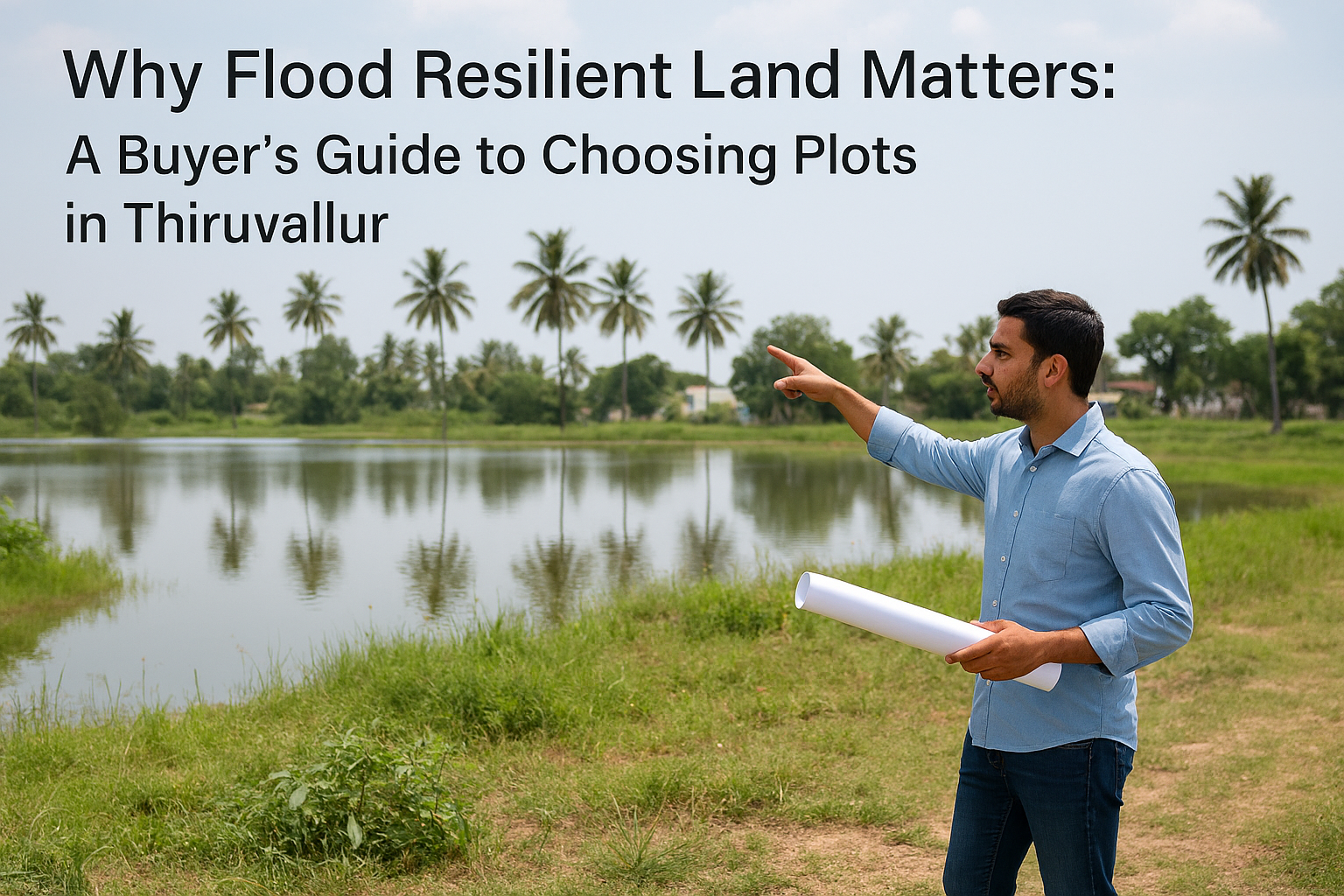
Buying land is a significant long term investment, it ensures a future home and a legacy asset. While taking this decision, factors such as location, road access, and pricing are usually factors in early decision, one aspect that needs equal consideration, especially in protecting the value of land over time, is flood resilience. In recent years, homebuyers and investors across Chennai and its suburbs have become more cautious due to changing rainfall patterns and seasonal waterlogging, and are prioritising this important factor.
For those exploring plots in developing corridors like Thiruvallur, understanding how flood safe land is identified can help avoid long term risks and ensure steady appreciation. Let us try to understand more about why flood resilient land matters and what aspiring buyers should evaluate before finalising a plot purchase.
What Flood Resilient Land Actually Means
Flood resilient land refers to plots that are naturally positioned and properly planned to manage excess rainwater without prolonged waterlogging or soil damage. Apart from elevation, a combination of terrain, drainage planning, and infrastructure determines how well a plot performs during heavy rainfall.
Flood safe plots typically include the following characteristics –

Natural Elevation and Land Contour
One of the most important indicators of flood safety is elevation. Plots located on naturally higher ground allow rainwater to flow away instead of stagnating.
Land with a gentle slope supports natural drainage and reduces pressure on surface infrastructure. In contrast, low lying parcels often depend heavily on external drainage systems, which may not always perform consistently.
In regions like Thiruvallur, large land parcels with good elevation are being developed into plotted communities like Urbanise Orchid Greens. This elevation plays a key role in long term land usability.
Soil Quality and Water Absorption Capacity
Soil type directly affects how land responds to rainfall. Well compacted soil with balanced absorption capacity supports quicker water percolation and maintains ground stability.
Before development begins, reputed developers like Urbanrise conduct soil testing to understand load bearing capacity and moisture behaviour. This process helps in planning proper road levels, plot heights, and stormwater systems.
Plots developed without soil assessment are more prone to erosion, uneven settlement, and surface damage during monsoons.
Stormwater Drainage Planning Within the Layout
Flood resilience depends heavily on how internal drainage is designed.
Well planned layouts like Urbanrise Orchid Greens in the developing Thiruvallur region, include:
-
Dedicated stormwater drains
-
Proper gradients along internal roads
-
Clear discharge paths that connect to external drainage channels
These systems work together to ensure rainwater is channelled out efficiently instead of collecting within the layout. In plotted developments, internal drainage quality often determines how usable the land remains during extended rainy periods.
Road Levels and Plot Formation
The relative height between plots and internal roads is another important factor.
In flood safe layouts, roads are typically laid at a slightly lower level than plots. This allows surface water to move along the road network and into drainage channels, protecting individual plots from water accumulation.
Proper plot formation also ensures uniform levels across the layout, reducing isolated low points that may collect water.
Why Flood Safety Should Be a Priority for Plot Buyers
Land is a long term asset. Its value and usability depend on how well it performs across different seasons.
-
Flood resilient land protects soil strength and boundary stability.
-
Plots that remain dry during monsoons are easier to develop in the future.
-
Maintenance costs related to refilling, levelling, and erosion are reduced.
-
Buyer confidence and resale demand remain consistent over time.
For investors, flood safety directly impacts liquidity. End users prefer plots that are ready for construction without additional groundwork.
Thiruvallur – A Growing Zone for Flood Safe Plot Development
Thiruvallur has emerged as a promising destination for plotted developments due to its expanding road connectivity, availability of large land parcels, and increasing residential demand.
Several pockets within Thiruvallur benefit from naturally elevated terrain, making them suitable for long term residential use. This has encouraged the development of gated villa plot communities like Orchid Greens, that focus on infrastructure quality and flood resilience rather than fragmented land divisions.
Developers like Urbanrise with decades of experience in township planning are placing greater emphasis on drainage, road formation, and plot elevation to align with evolving buyer expectations.
Flood Resilient Plotted Communities in Thiruvallur
Modern plotted developments in Thiruvallur are moving beyond basic land subdivision. Integrated planning is now a key differentiator.
Projects such as Urbanrise Orchid Greens, Thiruvallur, reflect this shift by focusing on elevated land selection, structured drainage systems, and clearly defined plot formation. Such developments are designed to support long term land performance rather than short term transactions.
For aspiring buyers, choosing plots within planned communities reduces uncertainty related to infrastructure execution and long term maintenance.
Checklist for Choosing Flood Safe Plots in Thiruvallur
The following checklist would help buyers to make a smart investment. Before finalising a land purchase, buyers should –
-
Check whether the land is naturally elevated compared to surrounding areas
-
Ask if soil testing has been conducted before development
-
Review stormwater drainage plans within the layout
-
Observe road levels in relation to plot height
-
Visit the site during or after rainfall if possible
-
Understand how excess water is discharged outside the layout
-
Prefer gated plotted developments with planned infrastructure
-
Verify approvals and layout planning standards
This evaluation helps in identifying plots that offer both safety and long term value.
Conclusion
Buying land is not only about location or price. It is about choosing a site that remains stable, usable, and valuable across decades. Flood resilient land plays a crucial role in protecting that value.
In growing regions like Thiruvallur, where plotted developments are expanding rapidly, prioritising elevation, drainage, and layout planning can make a meaningful difference. A well chosen plot offers confidence today and flexibility for the future, making it a safer investment in Chennai’s evolving real estate landscape.